The Fall That Changes Everything: Why Balance Training Matters More After 50
One moment you’re walking down the stairs at Cabot Circus. The next, you’ve missed a step, and everything changes. For many people over 50, a fall isn’t just an embarrassing stumble – it’s a life-altering event that can mean the difference between independence and assistance, confidence and fear.
The statistics are stark: falls are the leading cause of injury-related death in adults over 65 in the UK. But here’s what most people don’t realise – the decline in balance that leads to these falls doesn’t begin in your sixties or seventies. It starts much earlier, and the time to address it is now.
If you’re over 50 and haven’t yet considered balance training as essential to your fitness routine, this article will explain exactly why it should be your priority, backed by scientific evidence and practical solutions right here in Bristol.
The Silent Decline: What Happens to Your Balance After 50
Balance isn’t a single skill – it’s a complex interplay between multiple body systems that all decline with age:
Vestibular System Changes: Your inner ear contains tiny organs that detect head position and movement. After age 40, these structures begin to deteriorate, with significant decline accelerating after 55. Research published in Frontiers in Neurology shows that vestibular function decreases by approximately 40% between ages 40 and 70.
Proprioception Decline: Proprioception is your body’s ability to sense where it is in space. Sensory receptors in your muscles, tendons, and joints send constant feedback to your brain. With age, these receptors become less sensitive. Studies indicate that proprioceptive acuity decreases by up to 60% in adults over 65 compared to younger adults.
Visual Processing Slowdown: Your vision doesn’t just help you see obstacles – it’s crucial for maintaining balance. Age-related changes in visual acuity, depth perception, and contrast sensitivity all contribute to balance difficulties. The time it takes your brain to process visual information and adjust your position increases with age.
Muscle Response Time: Even if your brain detects that you’re losing balance, your muscles need to respond quickly enough to prevent a fall. Research shows that muscle reaction time can slow by 15-20% in adults over 50, meaning there’s a crucial delay between sensing imbalance and correcting it.
Cognitive Decline: Balance requires significant brain processing power. As we age, the cognitive resources needed for balance compete with other mental tasks. This is why older adults are more likely to fall when distracted – their brains struggle to manage multiple demands simultaneously.
The Cascade Effect: How One Fall Changes Everything
Falls in adults over 50 rarely happen in isolation. They trigger a devastating cascade of consequences:
Physical Injury: Hip fractures are the most serious fall-related injury. In the UK, approximately 76,000 hip fractures occur annually, with 90% in people over 65. Even with treatment, 20-30% of hip fracture patients die within one year, and many survivors never regain their previous level of independence.
Fear of Falling: Perhaps even more insidious than the physical injury is the psychological impact. Post-fall syndrome – the fear of falling again – affects up to 70% of older adults who’ve experienced a fall. This fear leads to activity restriction, which creates a vicious cycle of further physical decline.
Social Isolation: Fear of falling often causes people to avoid social activities. They stop attending community events, visiting friends, or even going to the shops independently. This isolation is linked to increased rates of depression and cognitive decline.
Loss of Independence: Falls are one of the primary reasons older adults move from independent living to assisted care. The physical and psychological toll can quickly erode the confidence and capability needed for independent daily life.
Accelerated Physical Decline: When people restrict activity due to fear of falling, they experience rapid deconditioning. Muscle strength decreases, flexibility diminishes, and balance worsens – making future falls even more likely.
The Menopause and Post-Menopause Factor
For women, hormonal changes compound balance challenges:
Bone Density Loss: The oestrogen decline during menopause accelerates bone loss, making fractures from falls more likely and more severe. Women can lose up to 20% of bone density in the first 5-7 years post-menopause. If you’re experiencing bone density concerns, our article on the muscle-bone balance connection explains why these systems decline together and how training addresses both.
Vestibular Changes: Some research suggests that hormonal fluctuations may affect inner ear function, though this area needs more study. What’s clear is that many women report dizziness and balance issues during perimenopause.
Visual Changes: Hormonal changes can affect eye health, including dryness and changes in visual acuity, which impact balance.
Muscle Mass Decline: As we covered in our article on strength training after 30, women lose muscle mass more rapidly after menopause—up to 3-5% per decade. This decline directly affects stability and your ability to prevent falls, as weaker leg muscles mean slower reaction times when you start to lose balance.
Why Traditional Gyms Miss the Mark on Balance Training
Here’s an uncomfortable truth about most gym-based fitness programmes: they focus on strength and cardiovascular fitness but largely ignore functional balance training.
Gym equipment is designed to be stable. Smith machines guide your movement. Leg press machines support your back. Chest press machines control the path of motion. While these build strength, they don’t train the very thing older adults need most: the ability to maintain stability in unpredictable, real-world situations.
You don’t fall in a controlled environment with perfect lighting and stable surfaces. You fall when:
- Stepping off a curb in the rain on Park Street
- Turning quickly at the Christmas Market
- Reaching for something whilst carrying shopping
- Walking on uneven pavement in Clifton Village
- Navigating stairs at Temple Meads station
This is where outdoor training offers genuine advantages that gym equipment cannot replicate.
The Outdoor Training Advantage for Balance
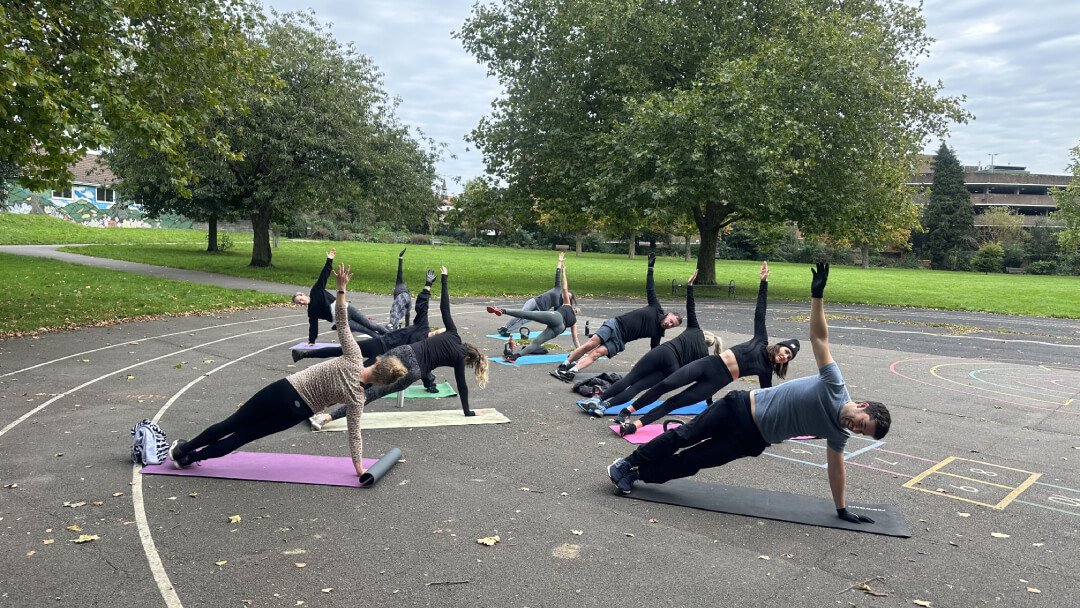
At Hive Fitness Bristol, our outdoor training environment at Redcatch Park provides something gyms struggle to offer: real-world balance challenges in a safe, supervised setting.
Uneven Terrain: Natural ground surfaces provide constant micro-adjustments that train your proprioceptive system. Research in Gait & Posture journal demonstrates that training on varied terrain improves balance more effectively than stable surface training.
Environmental Awareness: Training outdoors requires constant visual scanning and environmental awareness – the same skills needed to prevent falls in daily life. You learn to notice changes in surface texture, avoid obstacles, and maintain stability despite distractions.
Functional Movement Patterns: Our sessions incorporate movements that directly translate to daily activities: stepping patterns, directional changes, reaching whilst maintaining stability, and recovery techniques when you start to lose balance.
Progressive Challenge: From grass to slight slopes to varied textures, outdoor environments offer natural progression without requiring specialised equipment.
Confidence Building: Training in conditions similar to real life (wind, light changes, distractions) builds practical confidence that transfers to daily activities around Bristol.
The Science-Backed Solution: What Balance Training Actually Achieves
Research consistently shows that targeted balance training can significantly reduce fall risk:
Fall Risk Reduction: A systematic review in The BMJ found that exercise programmes including balance training reduce fall risk by 23% in community-dwelling older adults. For those at high risk of falling, the reduction was even greater at 39%.
Improved Reaction Time: Regular balance training can improve muscle response time by 20-30%, providing crucial extra milliseconds to prevent a fall.
Enhanced Proprioception: Studies show that proprioceptive training can partially reverse age-related decline, improving joint position sense and spatial awareness.
Confidence Restoration: Beyond physical improvements, balance training significantly reduces fear of falling and increases confidence in daily activities.
Multi-System Benefits: Balance training doesn’t just improve balance – it enhances strength, flexibility, coordination, and cognitive function, all of which contribute to fall prevention.
Balance Training: What Really Works
Effective balance training must include multiple components:
Static Balance: Holding steady positions, progressing from two feet to single leg, with eyes open and then closed. This trains your vestibular system and proprioception.
Dynamic Balance: Moving whilst maintaining control – walking patterns, directional changes, reaching tasks. This replicates real-world demands.
Reactive Balance: Training your recovery responses when you start to lose balance. These “stumble drills” are crucial but often overlooked.
Dual-Task Training: Maintaining balance whilst performing cognitive tasks (counting backwards, answering questions). This trains your brain to manage multiple demands – essential for preventing falls in everyday life.
Strength Integration: Balance requires adequate lower body strength, particularly in ankles, knees, and hips. Balance training and strength training work synergistically. If you want to understand how muscle power differs from strength, this is crucial for older adults.
Why Hive Fitness Bristol’s Approach Works
Our outdoor group sessions naturally incorporate all these elements:
Real-World Environment: Redcatch Park provides the varied, unpredictable surfaces that train practical balance skills.
Supervised Safety: You train in challenging conditions but with expert supervision and peer support, providing safety whilst building capability.
Progressive Programming: Sessions accommodate all ability levels, from those just beginning balance training to those maintaining advanced skills.
Community Accountability: Regular attendance is crucial for balance training effectiveness. Our supportive group environment encourages the consistency needed for real improvement.
Indoor Continuity: During winter months, our indoor sessions at The Harbour Totterdown ensure year-round progression, with controlled environments for specific balance drills. This mirrors the principles of recovery after 40 – consistent, structured training with adequate rest.
Functional Focus: Every exercise relates directly to activities you do in Bristol – navigating pavements, managing stairs, moving confidently in crowds.
What Balance Training at Hive Actually Looks Like
You might be wondering what “balance training” actually means in practice. At Hive Fitness, we combine the natural challenges of outdoor terrain with specific exercises designed to improve stability, proprioception, and reactive balance:
Single Leg Romanian Deadlifts (RDLs): These train your proprioceptive system whilst building strength in the stabiliser muscles around your hips and ankles. Standing on one leg whilst hinging forward forces constant micro-adjustments that translate directly to real-world balance.
Bosu Ball Training: The unstable surface of a Bosu ball challenges your vestibular system and ankle stability in ways flat ground cannot. Squats, lunges, and single-leg stands on the Bosu create controlled instability that trains your reactive balance.
Pillar Holds: These isometric exercises (planks, side planks) build the core strength essential for maintaining upright stability. A strong core is your foundation for balance in every other movement.
Bulgarian Split Squats: By elevating your rear foot, you’re forced to balance and stabilise through your front leg whilst building single-leg strength. This directly improves your ability to catch yourself when stepping on uneven surfaces.
Ice Skater Jumps: These lateral jumps train power, coordination, and dynamic balance simultaneously. The explosive side-to-side movement mimics the quick reactions needed to prevent falls.
Hurdles: Stepping over hurdles trains hip mobility, spatial awareness, and the ability to control your body through varied ranges of motion—essential for navigating obstacles in daily life.
Combined with Redcatch Park’s natural terrain variations—grass, slight slopes, uneven surfaces—these exercises create a comprehensive balance training programme that prepares you for real-world scenarios, not just gym conditions.
The 50+ Wake-Up Call
If you’re over 50, ask yourself these questions:
- Do you sometimes feel unsteady when you stand up quickly?
- Have you noticed yourself reaching for support more often?
- Do you avoid certain activities because you worry about falling?
- Has your confidence in walking on uneven surfaces decreased?
- Do you feel less stable in crowded or busy environments?
If you answered yes to any of these, your balance system is already declining. The good news? This decline is largely reversible with appropriate training.
The Time to Act is Now
Every year you delay balance training is another year of decline. But here’s the crucial point: balance training is most effective when you start before you’ve had a serious fall.
After a fall, fear often restricts training progression. Confidence is harder to rebuild. Physical recovery may limit what you can do. The optimal time to address balance is now, whilst you’re still capable and confident.
Research shows that adults who begin balance training in their fifties and maintain it throughout their lives have significantly lower fall rates in their seventies and eighties. This isn’t just about preventing falls – it’s about maintaining the independence and confidence to live life fully.
Your Next Steps
Balance training isn’t something to delay until after a fall scares you into action. It’s a fundamental component of healthy ageing that should begin in your fifties, if not earlier.
Ready to take control of your balance and reduce your fall risk?
Join us at Hive Fitness Bristol for group training sessions specifically designed to improve balance, strength, and confidence. Whether in the outdoor environment of Redcatch Park or our indoor facility at The Harbour Totterdown, you’ll receive expert guidance and community support in a programme that addresses the real-world balance challenges Bristol residents face daily.
Book your trial session today and discover how balance training can help you maintain independence, confidence, and an active lifestyle throughout your fifties, sixties, seventies, and beyond.
Don’t wait for a fall to change everything. Take action now whilst you can build strength from capability rather than rebuild from fear.
Contact Hive Fitness Bristol to start your balance training journey and join Bristol’s most supportive fitness community focused on healthy, active ageing.
Related Reading
Why Strength Training Becomes Non-Negotiable After 30: The Science Behind Muscle Loss and How Bristol Residents Can Fight Back
When Did You Last Jump: The Science of Muscle Power and Why It Matters More Than Strength
Why You’re Losing Strength Faster Than Your Parents Did
The Muscle-Bone Balance Connection: Why They Decline Together
Recovery After 40: Why Your Body Needs More
The Metabolism Myth: Why You Can’t Out-Train a Slowing Metabolism
References
- Agrawal, Y., Carey, J. P., Della Santina, C. C., Schubert, M. C., & Minor, L. B. (2009). Disorders of balance and vestibular function in US adults: Data from the National Health and Nutrition Examination Survey, 2001-2004. Archives of Internal Medicine, 169(10), 938-944. Available at: https://pubmed.ncbi.nlm.nih.gov/19468085/
- Goble, D. J., Coxon, J. P., Wenderoth, N., Van Impe, A., & Swinnen, S. P. (2009). Proprioceptive sensibility in the elderly: Degeneration, functional consequences and plastic-adaptive processes. Neuroscience & Biobehavioral Reviews, 33(3), 271-278. Available at: https://pubmed.ncbi.nlm.nih.gov/18793668/
- Sherrington, C., Fairhall, N. J., Wallbank, G. K., Tiedemann, A., Michaleff, Z. A., Howard, K., … & Lamb, S. E. (2019). Exercise for preventing falls in older people living in the community. Cochrane Database of Systematic Reviews, 1(1). Available at: https://pubmed.ncbi.nlm.nih.gov/30703272/
- Sherrington, C., Michaleff, Z. A., Fairhall, N., Paul, S. S., Tiedemann, A., Whitney, J., … & Lord, S. R. (2017). Exercise to prevent falls in older adults: an updated systematic review and meta-analysis. British Journal of Sports Medicine, 51(24), 1750-1758. Available at: https://pubmed.ncbi.nlm.nih.gov/27707740/
- National Hip Fracture Database (NHFD). (2023). Annual Report 2023. Royal College of Physicians. London, UK. Available at: https://www.rcp.ac.uk/improving-care/resources/nhfd-annual-report-2023/
- Denkinger, M. D., Lukas, A., Nikolaus, T., & Hauer, K. (2015). Factors associated with fear of falling and associated activity restriction in community-dwelling older adults: A systematic review. The American Journal of Geriatric Psychiatry, 23(1), 72-86. Available at: https://pubmed.ncbi.nlm.nih.gov/25539147/
- Volpi, E., Nazemi, R., & Fujita, S. (2004). Muscle tissue changes with aging. Current Opinion in Clinical Nutrition & Metabolic Care, 7(4), 405-410. Available at: https://pubmed.ncbi.nlm.nih.gov/15192443/
- Sivaraman Nair, K. (2005). Aging muscle. The American Journal of Clinical Nutrition, 81(5), 953-963. Available at: https://pubmed.ncbi.nlm.nih.gov/15883415/
- Simonsick, E. M., Fan, E., & Fleg, J. L. (2006). Estimating cardiorespiratory fitness in well-functioning older adults: Treadmill validation of the long distance corridor walk. Journal of the American Geriatrics Society, 54(1), 127-132. Available at: https://pubmed.ncbi.nlm.nih.gov/16420209/
- Muehlbauer, T., Gollhofer, A., & Granacher, U. (2015). Associations between measures of balance and lower-extremity muscle strength/power in healthy individuals across the lifespan: A systematic review and meta-analysis. Sports Medicine, 45(12), 1671-1692. Available at: https://pubmed.ncbi.nlm.nih.gov/26467542/
- Granacher, U., Muehlbauer, T., Zahner, L., Gollhofer, A., & Kressig, R. W. (2011). Comparison of traditional and recent approaches in the promotion of balance and strength in older adults. Sports Medicine, 41(5), 377-400. Available at: https://pubmed.ncbi.nlm.nih.gov/21510715/
- Lesinski, M., Hortobágyi, T., Muehlbauer, T., Gollhofer, A., & Granacher, U. (2015). Effects of balance training on balance performance in healthy older adults: A systematic review and meta-analysis. Sports Medicine, 45(12), 1721-1738. Available at: https://pubmed.ncbi.nlm.nih.gov/26325622/
Get In Touch
If you have any questions or would like to find out more about these services, you can contact me via the website here Contact NowAreas Covered
I am based in South Bristol and offer group fitness classes in Knowle and Totterdown which is a short journey from: Bedminster, Ashton, Bower Ashton, Redcatch, Bishopsworth, Hartcliffe, Whitchurch, Hengrove, Brislington, St Anne's Windmill Hill and Southville

Services Overview
I offer outdoor group fitness classes in South Bristol, specialising in strength training for adults over 30 who want to combat muscle loss, improve bone density and maintain functional fitness. My approach is science-backed and supportive, creating a welcoming environment for all fitness levels. Classes focus on bodyweight training, resistance work and functional movement patterns that translate to everyday life. Sessions run at Redcatch Park with indoor options at The Harbour Totterdown during winter months. Classes are designed to build sustainable fitness habits within a supportive community where you can get fitter, stronger and move better at your own pace.